AMADIOHA
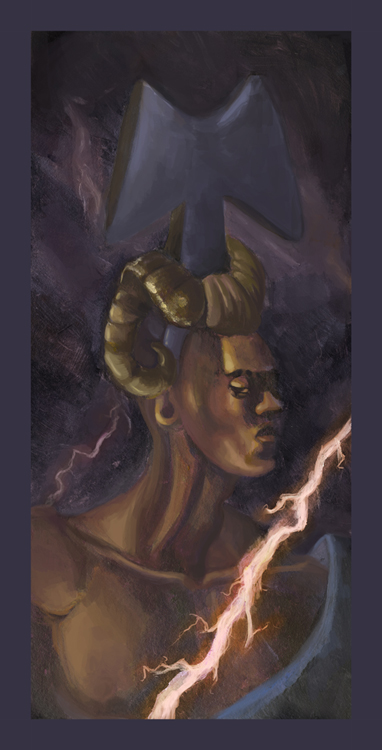
Amadioha (Igbo literal meaning "free will of the people"

is the Alusi (god) of thunder and lightning of the Igbo people of southeastern Nigeria. He is amongst the most popular of Igbo deities and in some parts of Igboland, he is referred to as Amadiora, Kamalu (which is short for Kalu Akanu),[1] Kamanu,[2] or Ofufe.[3] Astrologically, his governing planet is the Sun.[4] His color is red, and his symbol is a white ram.[5] Metaphysically, Amadioha represents the collective will of the people.[6] He is often associated with Anyanwu, who is the Igbo god of the Sun. While Anyanwu is more prominent in northern Igboland, Amadioha is more prominent in the southern part. His day is Afo, which is the second market day of the Igbo four day week.
Amadioha is one of the most popular of the Igbo deities. In fact, right after water spirits, the gods of thunder and lightning like Shango, Siete Rayos, Nzaji, etc seem to be the most well known and liked of all the deities all over Africa and its diaspora. Although he is usually referred to as Amadioha, that is not really a name, but one of his many epithets, which also include Igwe, Ofufe, and Igwekaala. The proper name of this entity would actually be Kamalu, or Kalu Akanu, and that’s the name that I use personally when referring to him.
Much of what is said about the other gods of thunder and lightning can be said about Amadioha: They serve as agents of justice, they are associated with war and aggression, and their colors tend to be red and white. People who have been accused of crimes go to their shrines to declare their innocence, less they be struck by lightning.
Unlike his fellow thunder and lightning deities, Amadioha doesn’t carry an object of power like Thor carries his hammer or like his second cousin Shango carries his axe. If he did carry something, I would assume it would be an Ogu stick, seeing as though its the symbol of justice. The ram is sacred to alot of the African thunder and lightning gods, both as a sacrifice and as a symbol. In fact, Amadioha at times appears to people in the form of a large white ram.

Even though the vast majority of Igbo people profess to be Bible believing Christians, belief in Amadioha still remains strong. I remember a conversation I had with a traditional ruler a few years ago while he was visiting the states about when he described an evening when he went outside during a storm and saw his the grass near his compound on fire, but not burning. Afterwards, a white ram appeared out of nowhere. When it was all over, it was like nothing had happened.
Amadioha is also still used to curse people or threaten them. I can’t count the number of times that I have heard the phrase “thunder fire you!” or ”Amadioha magbukwa gi!” (Amadioha will punish you!) Just the other day, I read an article where one of the priests of Amadioha proclaimed that the deity would punish any of the candidates if they dared try to rig the Governorship or House of Assembly polls in Nigeria. I personally would have more confidence in elected officials in Nigeria if they had to swear oaths at Amadioha’s shrine instead of swearing them on the Bible or Koran, and I’m pretty sure I’m not alone in that sentiment.
Although I was raised as a Christian, I was always very curious about what my ancestors believed and practiced. So I took it upon myself to actually research it. When I read about the Igbo deities, Amadioha was one that really stuck out to me for some odd reason. That affinity towards him never went away, and to this day, he’s one of my favorite of the Igbo Alusi.
When I was in the early days of my traditional practice, I was trying to figure out how I would make shrines and alters for the different deities. I asked some elders for images of the different Alusi and the response I got was one of amusement. They explained to me that trying to find an image of a Mmuo (spirit) was like trying to find an image of the wind, and that each picture or carving that you’ve ever seen of any of them is just an artistic representation of an invisible force.
Although I was raised as a Christian, I was always very curious about what my ancestors believed and practiced. So I took it upon myself to actually research it. When I read about the Igbo deities, Amadioha was one that really stuck out to me for some odd reason. That affinity towards him never went away, and to this day, he’s one of my favorite of the Igbo Alusi.
When I was in the early days of my traditional practice, I was trying to figure out how I would make shrines and alters for the different deities. I asked some elders for images of the different Alusi and the response I got was one of amusement. They explained to me that trying to find an image of a Mmuo (spirit) was like trying to find an image of the wind, and that each picture or carving that you’ve ever seen of any of them is just an artistic representation of an invisible force.
 Origins
Shrines to Amadioha still exist in different parts of Igboland, but the main shrine is located at Ozuzu in Ahoada Local Government Area of present day Rivers State, Nigeria. Although it is located there, it is not the patron deity of the people of Ozuzu. In fact, it is said that Ozuzu is the town in which Amadioha "lives" and it serves as it earthly headquarters. It is from there that it spread to other parts of Igboland.
[size=12pt]
Functions of Amadioha
God of justice
Amadioha is first and foremost known as a god of justice. He speaks through thunder, and he strikes with lightning. He creates thunder and lightning by casting "thunderstones" down to earth.[9] Persons judged guilty by Amadioha are either killed by lightning (which leaves a black mark on the forehead) or attacked by a swarm of bees.[10] The property of the victim is usually taken by the priests of Amadioha, and the body is left unburied and the victim unmourned, as the punishment is considered to be a righteous one from God.[11] In some parts of Igboland, Amadioha is used as a curse word.[12] Oaths are often sworn to him, which can carry deadly penalties when broken.
The ritual cleansing for Amadioha is very costly and tasking. The deity can only be appeased by transferring the curse to a live goat that is let loose outside of the walls of the community.[13] The ram is a common offering for him.[5] The priestly clan of Amadioha are known as Umuamadi, which translates to children of Amadioha.[14]
God of love, peace and unity
Besides justice, Amadioha is also a god of love, peace and unity, and is prayed for increase of crops, children in the home, and benevolence.[15] Aside the above manifestations of Amadioha, he represents, as different from most African religious world views, a messianic hope for those in critical situations.
God the Creator
Amadioha is also considered to be a creator God. In some traditions, human beings were made by him when he sent a bolt of lightning down to strike a silk cotton tree, which split and revealed a man and a woman.[16]
Consort to Ani
Amadioha is often shown as a husband to Ani, who is the Earth mother. In some Igbo traditions, the pair are said to be the first Alusi to have been created by Chukwu. The two are often honored with Mbari houses, which were made with mudbrick. Amadioha is typically depicted as a fair-skinned, titled gentleman of cool temper who is the patron of "light skinned Igbos" and "men of exalted rank."[17] While Ani is considered to be the lawmaker of Igbo society (which is known as Odinani), Amadioha is the enforcer and protector of the law.
God of Carvers
In the play, the Other Side of the Mask, the character Jamike refers to Amadioha as "the god of carvers" and identifies him further as "the god that sends lightning to kill the evil spirits who inhabit the trees from which carvers hew their wood.[18]
Personal spirit
Amadioha as a personal shrine is a spirit of enterprise that brings wealth. It is also a representative of the head of the household.[19]
Oracle
In precolonial times, the village of Ozuzu turned Amadioha/Kamalu into an oracle called Kamalu Ozuzu.[4] People would travel all over Igboland to visit the oracle in order to settle disputes and for help with crucial decisions. Parties found guilty by the oracle could be sold into slavery.
Proverbs and prayers associated with Amadioha
"Amadioha magbukwa gi" (Amadioha will punish you)
"Chi m le kwee - O wuru si o wuni mere ihea, amadioha magbukwe m" (My god please see- If it is true that I did this thing, let Amadioha Kill me).
http://odinanilawsofnature.wordpress.com/2011/05/18/amadioha-the-igbo-god-of-thunder-and-lightning/
http://en.wikipedia.org/wiki/Igbo_mythology


 AMADIOHA

 OFFLINE
 is the Alusi (god) of thunder and lightning of the Igbo people of southeastern Nigeria. He is amongst the most popular of Igbo deities and in some parts of Igboland, he is referred to as Amadiora, Kamalu (which is short for Kalu Akanu),[1] Kamanu,[2] or Ofufe.[3] Astrologically, his governing planet is the Sun.[4] His color is red, and his symbol is a white ram.[5] Metaphysically, Amadioha represents the collective will of the people.[6] He is often associated with Anyanwu, who is the Igbo god of the Sun. While Anyanwu is more prominent in northern Igboland, Amadioha is more prominent in the southern part. His day is Afo, which is the second market day of the Igbo four day week.