ABURI: THE “SOVEREIGN NATIONAL CONFERENCE” THAT GOT AWAY
Written/Narrate By
Max Siullon
World Re-known Historian
29th July 2003.
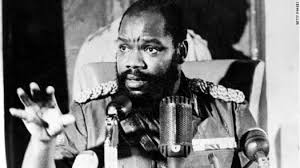
After Nigeria was dragged to the brink of the abyss by two military coups in 1966, its military leaders met to try to bring the country back from the brink. The meeting evolved into perhaps the best documented constitutional debate of all time which touched upon fundamental concepts regarding the balance of power between the central government and federating regions in a federation and professional soldiers’ outlook to military coups and seniority.
It was a potential breakthrough occasion. Between January 5th and 7th 1967, the memembers of that SMC. Following a second bloody army coup in July 1966, the mbers of Nigeria's then ruling military junta, the Supreme Military Council (SMC), met for the first time at Aburi in Ghana under the auspices of the Ghanaian Head of State: Lt-General Joe Ankrah. Ankrah was no stranger to coup plots as he had become Ghana’s first military Head of State after Ghana’s first President Kwame Nkrumah was deposed in a coup while Nkrumah was abroad visiting China. Ankrah was later forced to resign in April 1969 after admitting his role in a bribery scandal.
Ankrah had served in the Congo during the UN peace-keeping mission there in the early 1960s and it is likely he personally knew the Nigerian soldiers (including Ironsi, Fajuyi, Ojukwu and Gowon) who served in the same mission. The meeting at Aburi was the first official meeting of all Military Governor of the eastern region of Nigeria: Lt-Colonel 'Emeka' Ojukwu had refused to attend any SMC meeting outside the eastern region of Nigeria due to concerns over his safety.
The massacre of tens of thousands of Igbos in northern Nigeria only heightened Ojukwu's sense of isolation and insecurity. In turn, Ojukwu's public distrust towards the SMC (whom he suspected of tacitly supporting, or having a hand in the massacres) served to antagonised the SMC, who began to suspect that Ojukwu was planning the secession of the eastern region from the rest of Nigeria.
The fashionable political theory being bandied about in Nigeria today is that a "Sovereign National Conference" (SNC) should be held to resolve the country’s constitutional problems and coup plotting culture. Many do not realise that Nigeria has already had half a dozen constitutional debates - none of which has ever resolved the nagging problems which have dogged Nigeria from independence till today.
Nigeria has wasted billions of Naira on constitutional debates and constitutions that are no longer in use, and a future SNC is unlikely to discuss anything that has not already been covered in the previous constitutional debates. Ironically the best recorded of these constitutional debates was never implemented, and Nigeria has been paying the price since. To plan for the future Nigeria might do well to go back into its archives and learn from the "SNC" which it has already had.
THE ONE AMBITIOUS MAN AND THE REST OF THE COUNTRY QUOTE.
In the months preceding Aburi the SMC and Ojukwu had engaged in a war of words with the two sides trading multiple accusations and blaming each other for causing or exacerbating the crisis. The Military Governor of the north: Lt-Colonel Hassan Usman Katsina dismissed Ojukwu's confident and eloquent public statements on the crisis as attempts by Ojukwu "to show how much English he knows or learned at Oxford".
As far as Katsina was concerned, Nigeria's problem was a stand-off "between one ambitious man and the rest of the country". Throughout the six months following the coup of July 29th 1966, Ojukwu repeated his mantra that "I, as the Military Governor of the east cannot meet anywhere in Nigeria where there are northern troops". That virtually ruled out an SMC meeting inside Nigeria's borders. Ojukwu had even turned down offers to attend an SMC meeting on board a British (whom Ojukwu, and Igbos in general did not entirely trust) naval ship, and at Benin, but was finally convinced to attend in the neutral territory of Aburi in Ghana. Ojukwu's aides (WHICH INCUDES MY FATHER/AN UNCLE)were not without doubt.
Some warned him that the Aburi meeting could be a trap set by anti-Igbo members of the Federal Government to arrest or kill him. Ojukwu brushed aside their concerns by pointing out that he had received a guarantee of safe passage from Lt-Colonel Gowon, and that he had to trust Gowon's word as an officer and a gentleman. Virtually everything discussed at that Aburi conference is relevant till today. So much so that a reader would be tempted to believe that the discussion was on Nigeria's current problems, rather than over 40 years earlier, in 1967.
It is probably the best recorded constitutional debate in history. Aware that something momentous was occurring, the Ghanaians had the conference tape recorded. The tape of the discussions was later released by Ojukwu as a series of six long playing gramophone records.
In attendance on the Nigerian Federal Military Government (FMG) side were:
NAME & POSITIONS
Lt-Colonel Yakubu Gowon: Head of the SMC*
Commodore Joseph Akinwale Wey: Head of the Nigerian Navy
Colonel Robert Adeyinka Adebayo: Military Governor of the western region
Lt-Colonel Hassan Usman Katsina: Military Governor of the northern region
Lt-Colonel David Akpode Ejoor: Governor of mid-west region
Major Mobolaji Johnson: Military Governor of Lagos
Alhaji Kam Selem: Inspector-General of Police
Timothy Omo-Bare: Police Affairs
Official Eastern delegation:
Col Emeka Ojukwu (Only): Governor of South East
(*Head of the SMC as Ironsi’s whereabouts were “unknown”)
Ojukwu was in attendance as the eastern region's Military Governor. The FMG delegation arrived "wreathed in smiles" and anxious to mollify their former brother-in-arms Ojukwu. Colonels Adebayo and Gowon even offered to embrace Ojukwu. However Ojukwu was still stung by the terrible massacres of his Igbo kinsmen in northern Nigeria the previous year and was in no mood to embrace his former colleagues. The contrast in the demeanor of the participants was in itself a microcosm of what took place over the course of the next two days. While the federal delegation behaved as if the Aburi conference was a social gathering to reunite former friends who had fallen out in a social tiff, Ojukwu saw the conference for what it really was: a historic constitutional debate that would determine Nigeria's future social and political structure.
Typically, western world’s perspective was focused on image, rather than on the genuine problems of the protagonists. As secret diplomatic dispatches later declassified by the United States State Department depicted the FMG-eastern region stand-off as a personality clash between Ojukwu and Gowon. According to the American perspective: "many Americans admire Ojukwu. We like young, intelligent and romantic leaders, and Ojukwu has panache, quick intelligence and an actor's voice and eloquent/fluency. The contrast with Gowon - troubled by the enormity of his task, not Bottom educated, painfully earnest and slow to react, hesitant and repetitive in speech - led some Americans to view the Nigerian-Biafran conflict as a personal duel between two mismatched individuals".
As they were busy fighting in Vietnam and fighting a "cold war" against the USSR, the Americans did not become militarily or politically involved in the dispute. Instead, treating the conflict as one falling within Britain's sphere of influence.
THE REUNION OF FORMER COLLEAGUES
The Ghanaian host Lt-General Ankrah made a few introductory remarks and reminded his guests that "the whole world is looking up to you as military men and of there is any failure to reunify or even bring perfect understanding to Nigeria as a whole, you will find that the blame will rest with us through the centuries".
Ankrah added that although he understood that the eastern region/rest of Nigeria stand-off was an internal matter for Nigerians, they should not hesitate to ask him for any help should they feel the need. Although Commodore Wey played an avuncular role, the discussion revolved around the younger Colonels: Adebayo, Ejoor, Katsina, Ojukwu. and Gowon.
Ojukwu showed from the beginning that he was prepared for serious business. He arrived at the conference armed with detailed notes, and army of secretaries. The extent of Ojukwu’s pre-preparation is shown by the fact that he gave the other debaters copies of documents he had prepared in advance, which enunciated his ideas. The other debaters should have realised at this point, that something serious was going to occur. After the hostility and bitterness that preceded the Aburi meeting, the civilian observers were stunned at the camaraderie displayed by the military officers. The debaters threw off formality and addressed each other by their first names: "Emeka", "Bolaji", "Jack" (nickname of Lt-Colonel Gowon) were thrown around as if addressing each other in at a social gathering. One of Ojukwu’s secretaries was amazed to observe that “the meeting went on in a most friendly and cordial atmosphere which made us, the non-military advisers, develop a genuine respect and admiration for the military men and their sense of comradeship. The meeting continued so smoothly and ended so successfully…, that I for one, was convinced that among themselves, the military had their own methods”.
Ojukwu decided to show his good faith, and to test the good faith of the others by asking all present to renounce the use of force to settle the crisis. Ojukwu's motion was accepted without objection. While this request by Ojukwu may sound very noble, he was in fact playing a cunning soldier-politician. Ojukwu (despite his boasts of the eastern region's military prowess) realised that he could not succeed in a military campaign against the far more heavily armed FMG. By getting them to renounce the use of force, Ojukwu was trying to negate the FMG's military advantage. For he knew that if the political situation eventually got out of control, the FMG would find it difficult to resort to a military campaign having already given their word that they would not use force. This may have been an influential factor in Gowon's subsequent reluctance to engage the eastern region in a fully fledged war.
POLITICIANS
The assembled military officers struck a chord in unison on the subject of politicians. All of them voiced their contempt for the behaviour of civilian politicians whom they blamed for the wholesale bloodletting of the previous years (ignoring the fact that more Nigerian civilians had been murdered by politically motivated violence, in the one year of military rule so far, than in the preceding five years of civilian democratic rule). Commodore Wey slammed the point home rather forcefully when he declared that "Candidly if there had ever been a time in my life when I thought somebody had hurt me sufficiently for me to wish to kill him it was when one of these fellows [politicians] opened his mouth too wide".
IRONSI’S FATE
Despite Ironsi’s murder six months earlier, no public announcement regarding his death had been made and his whereabouts were still presumed unknown, although most of the SMC definitely knew he was dead. Gowon’s regime had eerily repeated the mistake made by Ironsi himself: failing to publicly acknowledge the army officers killed in a coup d’etat.
By not announcing Ironsi’s death, Gowon also made his own position tenuous and gave Ojukwu the opportunity to reason that since the Supreme Commander Ironsi was “missing”, only the officer directly behind Ironsi in army seniority could replace him as Supreme Commander. Major Mobolaji Johnson encapsulated the issue that the east was steadfastly refusing to recognize Gowon as Head of State while the other regions accepted him (albeit tentatively in the case of the west): “The main problem now is that as far as the east is concerned, there is no central government. Why? This is what we must find out. …, For all the east knows the former Supreme Commander [Ironsi] is only missing and until such a time that they know his whereabouts they do not know any other Supreme Commander. These are the points that have been brought out by the east.”
Ojukwu demanded that Gowon make a categorical public statement on the fate of Ironsi. Ejoor supported this by flatly requesting “we want to know what happened to Ironsi and Fajuyi”. Despite Ojukwu’s request for an announcement, most, if not all the participants already knew that Ironsi had been murdered. But the surprising fact was the silent of the Yoruba personnels in the meeting , knowing the fact that their brother Fajuyi was also declared missing.
Gowon was informed of the death of Ironsi and Fajuyi not long after they had been killed. Gowon’s ADC Lt William Walbe was one of the junior northern soldiers that led Ironsi and Fajuyi into a bush alongside Iwo road outside Ibadan and murdered them there. Colonel Adebayo had ordered a search for their bodies, which were eventually discovered by the police. The head of the police Kam Selem would have been informed when his men discovered the bodies.
Although Ojukwu was several hundred miles away in the east when Ironsi and Fajuyi were murdered, he likely would have had the story of their death relayed to him by one of Ironsi’s ADCs Captain Andrew Nwankwo who was captured along with Ironsi and Fajuyi but managed to escape moments before they were shot. Nwankwo eventually managed to find his way back to the east.
Commodore Wey acknowledged that all the debaters already knew what happened to Ironsi. Ojukwu simply wanted Gowon to publicly acknowledge what the SMC members already knew: that Ironsi was dead. Ojukwu later acknowledged that “I heard the rumour that he [Ironsi] had been assassinated, so I began making contacts because I wanted to force them out in the open so that we could start dealing with the real situation.”
Gowon agreed to make a public announcement, and Kam Selem concurred, although he counselled that “the statement should be made in Nigeria so that the necessary honour can be given”.
The soldiers agreed to make a public statement formally announcing Ironsi’s death shortly after they returned to Nigeria, and at this point, the microphones were switched off and the civilians were asked to leave the room. Gowon then narrated the grisly tale of how Ironsi and Fajuyi had been abducted from State House in Ibadan by junior northern soldiers (including Gowon’s ADC Lt Walbe) standing right behind them, driven out to an isolated bush outside Ibadan and shot there.
COUP PLOTTERS: OJUKWU'S PROPHECY


 ABURI ACCORD

 OFFLINE